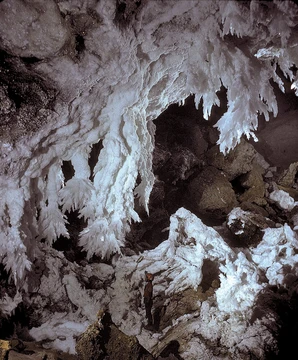
Postojna Cave
Second-longest cave system in Slovenia, major tourist attraction.

Postojna Cave (Slovene: Postojnska jama; German: Adelsberger Grotte; Italian: Grotte di Postumia) is a 24.34 km (15.12 mi) long karst cave system near Postojna, southwestern Slovenia. It is the second-longest cave system in the country (following the Migovec System) as well as one of its top tourism sites. The caves were created by the Pivka River.
- length
- 24.34 km (15.12 mi)
- location
- Near Postojna, southwestern Slovenia
- discovery_of_new_area
- 1818 by Luka Čeč
- first_scientific_overview
- 1850s by Adolf Schmidl
- electric_lighting_added
- 1884
- first_underground_post_office
- 1899
- open_to_public
- 5.3 km (3.3 mi)
Verified Timeline
Lore & Background
The cave was first described in the 17th century by the pioneer of study of karst phenomena, Johann Weikhard von Valvasor, although graffiti inside dated to 1213 indicates a much longer history of use. In 1818, when the cave was being prepared for a visit by Francis I, the first Emperor of Austrian Empire, a new area of the cave was discovered accidentally by Luka Čeč, a local man in charge of lighting lamps in the cave. In 1819, Archduke Ferdinand visited the caves, and Čeč became the first official tourist guide when the caves were opened to the public. In the 1850s, the Austrian-Czech geographer Adolf Schmidl published the first comprehensive scientific overview of the Postojna caves and the Pivka Basin, which became a standard reference point in the study of speleology. Electric lighting was added in 1884, preceding even Ljubljana, the capital of Carniola, of which the cave was part at the time. In 1872, cave rails were laid along with the first cave train for tourists; at first these were pushed along by the guides themselves, later at the beginning of the 20th century a gas locomotive was introduced. During World War I, Russian prisoners of war were forced to construct a bridge across a large chasm inside the cave. During World War II, German occupying forces used the cave to store nearly 1,000 barrels of aircraft fuel, which were destroyed in April 1944 by Slovene Partisans. The fire burned for seven days, destroying a large section of the cave and blackening the entrance. After 1945, the gas locomotive was replaced by an electric one.
Reader's Guide
Postojna Cave is significant as a natural and historical landmark, combining karst geology, early tourism infrastructure, and wartime history. About 5.3 kilometres (3.3 mi) of the cave system are open to the public. At the end of the 1990s it was one of the world's most visited show caves, with nearly 1 million tourists per year. In June 2015 and May 2017, the cave administration reported that cave divers managed to explore a further underwater section of the cave leading towards Planina Cave, thus lengthening the cave system from 20,570 m (67,490 ft) to 24,340 m (79,860 ft). The cave also houses the world's first and only underground post office which initially opened in 1899. The caves are home to the endemic olm, the largest troglodytic amphibian in the world. The tour through the caves includes an aquarium with some olms in it. On January 30, 2016, a female olm at the cave began to lay over 50 eggs; from the end of May to mid-July 2016, twenty-two baby olms successfully hatched. While the cave system is 24 km long, only 5 km is open to the public. Of this, 3.5 km is traversed by a train that takes visitors through the cave; the remaining 1.5 km can be navigated on foot and with a guide. The whole tour takes about 1.5 hours. The temperature inside the cave is around ten degrees Celsius (fifty degrees Fahrenheit). The permanent exhibition 'EXPO Postojna Cave Karst' was opened in April 2014; it is the largest permanent exhibition about the cave and karst phenomena around the world, featuring interactive presentations about the history of tourism-related development of the cave.
Did You Know?
- Graffiti inside the cave dated to 1213 indicates a much longer history of use than the first written description in the 17th century.
- Electric lighting was added in 1884, preceding even Ljubljana, the capital of Carniola.
- During World War II, German forces stored nearly 1,000 barrels of aircraft fuel in the cave; Slovene Partisans destroyed them in April 1944, causing a fire that burned for seven days.
- In 2016, a female olm at the cave laid over 50 eggs, and twenty-two baby olms successfully hatched from late May to mid-July.
- The cave houses the world's first and only underground post office, which initially opened in 1899.
Frequently Asked Questions
What is Postojna Cave?
Postojna Cave is a 24.34-kilometer karst cave system located near the town of Postojna in southwestern Slovenia. It is the second-longest cave network in the country, trailing only the Migovec System, and serves as one of Slovenia's premier natural tourist destinations.
How was Postojna Cave formed?
The Pivka River gradually dissolved through the surrounding limestone over countless millennia, carving out the vast tunnel network that makes up the system. That slow, persistent water erosion is what produced the passages visitors walk through today.
Who first explored the deeper sections of Postojna Cave?
In 1818, a local explorer named Luka Čeč pushed into previously unknown areas of the cave, significantly expanding what was known about the system. His pioneering work set the stage for the more rigorous scientific surveys carried out by Adolf Schmidl in the 1850s.
What milestones make Postojna Cave historically notable?
The cave was among the first underground sites to receive electric lighting, installed in 1884, and it hosted the world's first underground post office in 1899. These early innovations helped establish it as a landmark in the history of cave tourism.
Why is Postojna Cave important to Slovenia?
As the nation's second-longest cave system and a major draw for international visitors, it holds a prominent place in both Slovenian geology and tourism. Its three official names—Postojnska jama, Adelsberger Grotte, and Grotte di Postumia—mirror the layered cultural heritage of the region.
More in Caves And Karst Formations 1-24
Elsewhere in the Caves And Karst Formations universe
Spotted an error? Know more?
This is a living reference — every entry is fact-audited, and reader corrections feed straight into our audit queue. Suggest an edit · See this site's audit record