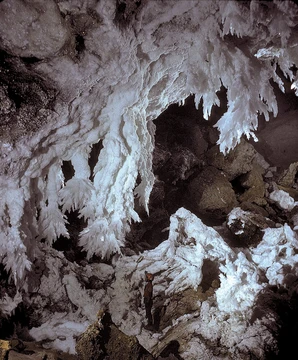
Neptune's Grotto
Stalactite cave discovered by fishermen in 18th-century Sardinia.

Neptune's Grotto (Italian: Grotta di Nettuno; Catalan: Cova de Neptú) is a stalactite cave near the town of Alghero on the island of Sardinia, Italy. Discovered by local fishermen in the 18th century, it has developed into a popular tourist attraction, named after the Roman god of the sea, Neptune.
- location
- Near Alghero, Sardinia, Italy
- discovery
- 18th century by local fishermen
- entrance elevation
- About 1 m (3 ft 3 in) above sea level
Lore & Background
The grotto is also accessible via short boat trips from Alghero, arranged hourly in summer and less frequently in spring and autumn. Two other grottoes lie nearby: the Green grotto, not open to tourists, and the Grotta di Ricami, accessible only from the sea.
Reader's Guide
Neptune's Grotto is significant as a natural landmark and tourist attraction on Sardinia. Its discovery by local fishermen in the 18th century led to its development as a popular destination, with guided tours offered in Italian and English through lit passages of stalactite and stalagmite formations. The cave's 120-metre saltwater lake and its history as a habitat for the Mediterranean monk seal (now extinct in the area) add to its interest. Its legacy lies in its natural beauty, tourism infrastructure, and cultural appearances.
Did You Know?
- The cave's 120-metre saltwater lake was historically a habitat for the Mediterranean monk seal, now extinct in the area.
- Two other grottoes lie nearby: the Green grotto, not open to tourists, and the Grotta di Ricami, accessible only from the sea.
Frequently Asked Questions
What is Neptune's Grotto?
Neptune's Grotto is a stalactite cave situated near the town of Alghero on Sardinia, Italy. It is named after Neptune, the Roman god of the sea, reflecting its coastal setting.
How was Neptune's Grotto discovered?
Local fishermen stumbled upon the cave in the 18th century. What began as a modest find among the cliffs gradually grew into one of Sardinia's most visited natural attractions.
How do visitors get down to the cave entrance?
The entrance sits only about one meter above sea level at the foot of the 110-meter Capo Caccia cliffs. To reach it, visitors descend a 654-step staircase known as the scala del cabirol, or 'goat's steps,' which was carved into the rock face in 1954.
How large is Neptune's Grotto?
The full cave system stretches roughly four kilometers (about 2.5 miles) in total length. However, only around 300 meters of the passage is open and accessible to the public.
Why is Neptune's Grotto notable among karst formations?
It is a striking example of coastal stalactite development, where sea-level karst processes have shaped the rock beneath towering cliffs. Its long history as a local discovery turned into a major tourist site makes it a reference point for how Sardinian karst landscapes are studied and preserved.
More in Caves And Karst Formations 1-24
Elsewhere in the Caves And Karst Formations universe
Spotted an error? Know more?
This is a living reference — every entry is fact-audited, and reader corrections feed straight into our audit queue. Suggest an edit · See this site's audit record