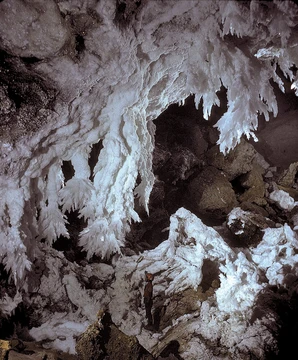
Leviathan Cave
Longest and deepest lava tube in Africa.

It is the longest and deepest known lava tube in Africa, spanning 11.5 km (7.1 mi) in overall length, though segmented by tectonic plate movement.
- length
- 11.5 km (7.1 mi)
- location
- Chyulu Hills National Park, Kenya
- type
- lava tube
- rank
- 11th-longest lava tube in the world
Verified Timeline
Lore & Background
These segments are considered separately when ranking length per international standard. The cave was formed by hot lava flowing beneath a cooled crust, like all lava tubes. In the 1980s, Leviathan Cave was the third-longest known lava tube in the world. However, modern surveys have found newer, longer tubes and have located longer passages of known tubes. It remains the longest tube in Africa but is now the 11th-longest lava tube globally.
Reader's Guide
Leviathan Cave holds significance as the longest and deepest lava tube in Africa, a record it retains despite being surpassed globally. The cave's segmentation by tectonic plate movement illustrates the dynamic geological processes affecting lava tubes over time. Its ranking shift from third-longest in the 1980s to 11th-longest today reflects ongoing exploration and survey improvements worldwide. The separate measurement of its Upper and Lower sections per international standard highlights the precision required in speleological ranking.
Did You Know?
- It is the longest and deepest known lava tube in Africa.
- In the 1980s, it was the third-longest lava tube in the world; it is now the 11th-longest.
Entry in the World Cave Registry
Leviathan Cave holds a place within a comprehensive global compilation of named caves, a collection that spans every inhabited continent and extends even to extraterrestrial bodies. Inclusion in this registry is not automatic; each entry must be substantiated by a verifiable Wikipedia link or a citation to a reliable published source, ensuring that only formally documented formations make the cut. The cave is organized within this list by its continental region and then by the specific nation in which it resides. This systematic approach means Leviathan Cave sits alongside entries from dozens of countries, from the arid landscapes of North Africa to the volcanic islands of the Pacific. The registry deliberately excludes caves that lack a published name, maintaining a standard of formal recognition for every entry it carries.
Geographic Placement and Sorting Conventions
The positioning of Leviathan Cave within the global list follows a strict two-tier sorting logic: continental region first, then the specific nation. This means its neighbors in the list are determined not by depth, length, or discovery date, but purely by geography. If the cave happens to sit in an overseas territory that belongs to a nation on a different continent, the sorting rule shifts—it is filed under the territory's own continent and name rather than its parent country's. This convention ensures the list reflects where the cave physically exists rather than where its political sovereignty lies. The continental sections range from Africa and Asia to Europe, the Americas, and Oceania, with each country heading potentially containing multiple named caves or remaining as a placeholder awaiting verified entries.
Distinction from Show Caves
A critical distinction in the cave cataloguing world is the separation between the general list of named caves and the dedicated list of show caves—those formations developed for public visitation. Leviathan Cave, as an entry in the broader registry, is not automatically a show cave. The show cave list is a standalone compilation restricted to sites that have been opened to the public, making them a subset of the larger collection. This separation matters for researchers, tourists, and speleologists alike, as it clarifies which caves are accessible and which remain in the domain of dedicated exploration. The existence of this parallel listing underscores that the majority of named caves worldwide are not open to casual visitors, preserving their natural state for scientific study and specialized caving expeditions.
Context Among Related Cave Records
Leviathan Cave exists within a broader ecosystem of cave documentation that extends well beyond a single alphabetical list. Companion compilations track the deepest caves on Earth, the longest cave systems, and the longest cave by individual country, each offering a different metric for comparison. The field of speleology also reaches beyond our planet: the first atlas of lunar pits appeared in 2021, with catalogues of Martian cave-like features published from 2014 onward, and as of 2007 seven putative entrances had been spotted on the flanks of Arsia Mons. For those seeking further information on caves like Leviathan, external resources include the National Caves Association's member directory, the World Cave Database, and community-built wiki databases maintained by cavers themselves, all of which supplement the formal registry.
Frequently Asked Questions
What is Leviathan Cave?
Leviathan Cave, also called the Grotte de Leviathan, is a lava tube situated in eastern Kenya. It holds the distinction of being both the longest and the deepest known lava tube on the African continent.
Where exactly is Leviathan Cave located?
It lies within the Chyulu Hills National Park in eastern Kenya, a region shaped by volcanic activity that produced the tube's basaltic passages.
How does Leviathan Cave rank among lava tubes worldwide?
At 11.5 kilometres of mapped passage, it sits as the 11th-longest lava tube on Earth. Within Africa, however, it tops both the length and depth charts, making it the continent's premier example of this geological formation.
More in Caves And Karst Formations 1-24
Elsewhere in the Caves And Karst Formations universe
Spotted an error? Know more?
This is a living reference — every entry is fact-audited, and reader corrections feed straight into our audit queue. Suggest an edit · See this site's audit record