Optymistychna Cave
Longest cave in Europe and longest gypsum cave in the world.

Optymistychna Cave (Ukrainian: Оптимістична, lit.
- location
- Near Korolivka, Chortkiv Raion, Ternopil Oblast, Ukraine
- type
- Gypsum cave
- discovered_by
- Lviv speleological club Cyclope
- classification
- Longest cave in Europe, seventh-longest in the world, longest gypsum cave in the world
- recognition
- Natural Wonder of Ukraine (2008)
Lore & Background
Since its discovery, more than 50 expeditions have taken place, but exploration has slowed significantly in recent years, with very little surveying currently being done.
Reader's Guide
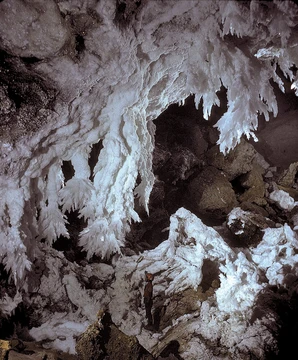
The cave lies under a 2-square-kilometer area in a Neogene period gypsum layer less than 30 meters thick. Passages are typically small—no more than 3 meters wide and 1.5 meters tall—but can reach 10 meters tall at intersections, and are often choked with mud. The cave is a dense, multi-level maze. Its gypsum bed is topped with limestone, which has seeped in and formed calcite speleothems; elsewhere, gypsum crystals tinted by mineral salts and large gypsum rosettes colored black by manganese oxide occur. Despite over 50 expeditions, exploration has slowed, and the cave remains incompletely surveyed.
Did You Know?
- Optymistychna Cave is the longest gypsum cave in the world.
- It is located near Priest's Grotto, the eleventh-longest cave in the world, but the two are not known to be connected.
- The cave was recognized as a Natural Wonder of Ukraine in 2008.
Frequently Asked Questions
What is Optymistychna Cave?
Optymistychna Cave is a gypsum cave system found near the Ukrainian village of Korolivka in Ternopil Oblast. Its name, which means 'optimistic' in Ukrainian, was assigned after its initial exploration in the Soviet era.
Where exactly is Optymistychna Cave located?
The cave system extends through the karst landscape near Korolivka, in Chortkiv Raion of Ternopil Oblast, in western Ukraine.
Why is Optymistychna Cave considered important to the speleology community?
Its combination of extreme length and gypsum geology makes it a unique benchmark among the world's longest caves, and it has served as a major reference point for understanding gypsum karst development in Europe.
More in Caves And Karst Formations 1-24
Related in Caves And Karst Formations
Links follow this subject's own source article.
Elsewhere in the Caves And Karst Formations universe
Spotted an error? Know more?
This is a living reference — every entry is fact-audited, and reader corrections feed straight into our audit queue. Suggest an edit · See this site's audit record