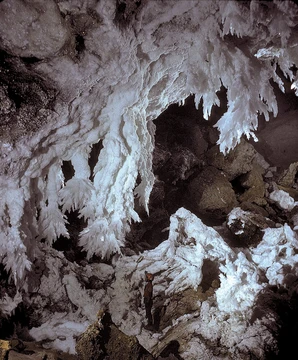
Lechuguilla Cave
A solutional cave formed by sulfuric acid dissolution.

Lechuguilla Cave in New Mexico and nearby Carlsbad Caverns are now believed to be examples of another type of solutional cave. They were formed by H2S (hydrogen sulfide) gas rising from below, where reservoirs of petroleum give off sulfurous fumes. This gas mixes with ground water and forms H2SO4 (sulfuric acid). The acid then dissolves the limestone from below, rather than from above, by acidic water percolating to the surface.
- location
- New Mexico, US
Lore & Background
Lechuguilla Cave in New Mexico is noted for large scale gypsum speleothems. It is an example of a solutional cave formed by H2S (hydrogen sulfide) gas rising from below, where reservoirs of petroleum give off sulfurous fumes. This gas mixes with ground water and forms H2SO4 (sulfuric acid). The acid then dissolves the limestone from below, rather than from above, by acidic water percolating to the surface.
Reader's Guide
Lechuguilla Cave in New Mexico is noted for large scale gypsum speleothems. It is an example of a solutional cave formed by H2S (hydrogen sulfide) gas rising from below, where reservoirs of petroleum give off sulfurous fumes. This gas mixes with ground water and forms H2SO4 (sulfuric acid). The acid then dissolves the limestone from below, rather than from above, by acidic water percolating to the surface.
Did You Know?
- Lechuguilla Cave in New Mexico is noted for large scale gypsum speleothems.
- Lechuguilla Cave and nearby Carlsbad Caverns are believed to be examples of another type of solutional cave.
- They were formed by H2S (hydrogen sulfide) gas rising from below, where reservoirs of petroleum give off sulfurous fumes.
- The acid dissolves the limestone from below, rather than from above, by acidic water percolating to the surface.
The Sulfuric Acid Origin
Lechuguilla Cave in New Mexico occupies a distinctive place in the taxonomy of solutional caves. While the vast majority of karst caves worldwide are carved by carbonic acid—rainwater and groundwater carrying dissolved CO2 that gradually eats through limestone—Lechuguilla is now understood to have been shaped by an entirely different chemical pathway. Deep beneath the surface, petroleum reservoirs release hydrogen sulfide gas. This sulfurous fume migrates upward and encounters groundwater, where a chemical reaction produces sulfuric acid. Unlike the familiar top-down dissolution of carbonic acid caves, this powerful acid attacks the limestone from below, hollowing out vast chambers in a fundamentally different geometric pattern. The nearby Carlsbad Caverns are now thought to share this same sulfuric acid genesis, making the region a natural laboratory for studying this rarer formation mechanism. The distinction matters because it explains why Lechuguilla's internal architecture and mineralogy differ from the more common carbonic acid systems found across the American West and beyond.
Gypsum Speleothems: A Rare Distinction
Among the many caves on Earth, very few are singled out for hosting large-scale gypsum speleothems, and Lechuguilla Cave is one of only two specifically noted for this extraordinary feature. The other is the Cave of the Crystals in Chihuahua, Mexico. Gypsum—chemically calcium sulfate, CaSO4, and sometimes referred to as alabaster—is a far less common host rock for cave formation than limestone, making gypsum karst a rarity in the geological record. The speleothems found in Lechuguilla represent slow precipitation of mineral deposits, a process that in limestone caves produces the familiar stalactites, stalagmites, flowstones, and columns. In Lechuguilla's case, however, the dominant mineral is gypsum rather than the calcium carbonate that typically adorns limestone cave walls. This sets the cave apart from the broader family of solutional caves, which are overwhelmingly limestone-based and decorated with calcite formations. The presence of these large gypsum structures makes Lechuguilla a subject of particular interest for researchers studying speleothem chemistry and the paleoclimatological significance of gypsum cave deposits.
The Karst Landscape Around Lechuguilla
Solutional caves like Lechuguilla do not exist in isolation; they are the visible expression of a broader geological process that reshapes entire landscapes. In the classic carbonic acid model, rainwater and groundwater charged with carbonic acid seep through bedding planes, faults, and joints in the bedrock, gradually dissolving the rock. Over immense timescales, the surface terrain fragments into clints separated by grikes, while sinkholes open up and streams vanish underground. Crevices widen as their walls are eaten away, eventually becoming caves or interconnected cave systems. When a roof finally gives way, the result is a large cavern or doline. Portions of any solutional cave that sit below the local groundwater table remain permanently flooded. Lechuguilla, though formed by the rarer sulfuric acid mechanism, still belongs to this family of karst topography—marked by sinkholes and subterranean drainage networks—where the limestone substrate, composed primarily of calcium carbonate, provides the raw material for dissolution. The surrounding New Mexico landscape thus carries the fingerprints of this slow, invisible chemical sculpting.
Lechuguilla Among the World's Caves
Lechuguilla Cave sits within a global family of solutional caves that spans every inhabited continent. In the United States alone, the limestone cave tradition includes Jewel Cave in South Dakota, Mammoth Cave in Kentucky, Wind Cave in South Dakota, Oregon Caves in Oregon, and Cumberland Caverns in Tennessee, among others. Across the Pacific, Hang Sơn Đoòng in Vietnam's Quảng Bình Province and Black Dwarf Cave in Taiwan's Pingtung County represent the same fundamental dissolution process at work in different tectonic settings. In Europe, Germany's König-Otto-Tropfsteinhöhle and Australia's Jenolan Caves in New South Wales join the roster. Yet Lechuguilla occupies a special niche: it ranks among the grandest and most prolific solutional cave systems carved in limestone, while simultaneously being distinguished by its large-scale gypsum speleothems—a feature shared only with the Cave of the Crystals in Mexico. This dual identity, combining the grandeur of a major limestone karst system with the rarity of significant gypsum formations, places Lechuguilla in a category of its own within the global cave inventory.
Frequently Asked Questions
What is Lechuguilla Cave and where is it located?
Lechuguilla Cave is a major underground passage system situated within Carlsbad Caverns National Park in New Mexico. It takes its name from the canyon used to enter it, which is itself named after the agave plant (Agave lechuguilla) that grows in that area.
How big is Lechuguilla Cave?
The cave stretches 152.11 miles (244.80 km) in total explored length, ranking it ninth-longest in the world. Its deepest measured point reaches 1,588.6 feet (484.2 m), making it the seventh-deepest cave in the United States.
What makes Lechuguilla Cave geologically special?
The cave is celebrated for its extraordinary variety of rare speleothems and unusual mineral formations found nowhere else in such abundance. It remains in a remarkably pristine state, largely untouched by tourism or heavy human traffic.
Can the general public visit Lechuguilla Cave?
No, access is strictly limited to approved scientific researchers, survey and exploration teams, and National Park Service personnel. This restriction helps preserve the cave's delicate formations and unspoiled condition.
What is the deepest single drop in Lechuguilla Cave?
The deepest known pit in the cave is called Kansas Twister, which plunges more than 510 feet (160 m) in a single shaft. Large passages were first discovered in the cave on May 25, 1986, opening up new sections for exploration.
More in Caves And Karst Formations 1-24
Related in Caves And Karst Formations
Links follow this subject's own source article.
Elsewhere in the Caves And Karst Formations universe
Spotted an error? Know more?
This is a living reference — every entry is fact-audited, and reader corrections feed straight into our audit queue. Suggest an edit · See this site's audit record