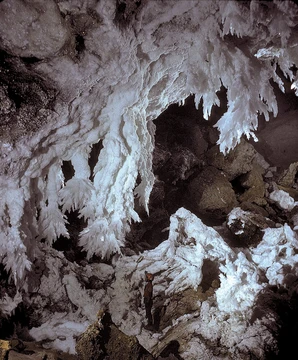
La Verna Cave
World's largest show cave chamber, formed by dissolution and collapse.

La Verna is a show cave located in the commune of Sainte-Engrâce in the Pyrénées-Atlantiques department of France. It contains the Salle de la Verna, the largest chamber in any show cave in the world, notable for its immense dimensions and the river that cascades into it.
- chamber_volume
- 3.6 million cubic metres (127,000,000 cu ft)
Verified Timeline
Lore & Background
They met in the chamber and inscribed their names, finding what was then the world's largest known underground chamber. The unconformity between Paleozoic and Mesozoic rocks is clearly exposed in the chamber walls.
Reader's Guide
La Verna Cave holds significance as the site of the world's largest show cave chamber, the Salle de la Verna, with a volume of 3.6 million cubic metres.
Did You Know?
- The Salle de la Verna has a diameter of 245 metres (804 ft) and a height of 194 metres (636 ft).
- A standard four-person hot-air balloon was flown inside the chamber in 2003.
- The chamber was named after the Lyon scouts, La Verna Troop, who helped in the attempted rescue of Marcel Loubens.
- The cave opened to the public on 1 July 2010, including access for those with reduced mobility.
Place in the Global Cave Registry
La Verna Cave occupies a position within a broader international framework for documenting subterranean formations. The global cave listing system operates under specific editorial standards: any cave appearing in the registry must be backed by a verifiable Wikipedia link or a citation to a reliable source. The entries are organized first by continent and then by the country in which the cave resides, creating a hierarchical structure that makes it straightforward to locate a particular site within its geographic context. For caves situated in overseas territories that belong to a different continent than their parent nation, the sorting follows the territory's own continental placement rather than the home country's. La Verna Cave, being located in Italy, falls under the European section of this registry, alongside numerous other nations from Austria to the United Kingdom. The system also maintains a separate compilation dedicated exclusively to show caves—those formations that welcome public visitation—distinguishing them from the broader catalogue of named caves.
European Cave Context
Within the European portion of the global cave registry, Italy stands as one of many nations contributing to the continent's subterranean heritage. The European section spans an extensive range of countries, from Austria and Belgium through to Ukraine and the United Kingdom, each with its own entries. Among the specifically named caves in this continental grouping are Badanj Cave in Bosnia and Herzegovina, noted as both a cave and an archaeological site in Herzegovina, and Vjetrenica, recognized as the largest cave in that same country. In North Macedonia, Pešna is listed, while in the Asian section, Lobster Cave appears under Taiwan. La Verna Cave shares this European listing context with dozens of other nations, each contributing their own subterranean formations to the collective record. The registry treats all these entries with equal structural weight, sorting them alphabetically within their respective countries and ensuring that each named cave meets the verification threshold of a reliable source or encyclopedic link before inclusion.
Cave Science and Documentation
The study and documentation of caves like La Verna Cave falls under the broader discipline of speleology, the scientific field dedicated to understanding subterranean environments. The global cave registry connects to several specialized reference works, including dedicated lists of the deepest caves, the longest caves, and the longest cave by individual country, providing comparative frameworks for researchers and enthusiasts alike. External resources further enrich the documentation landscape: the National Caves Association maintains a Member Caves Directory, while independent databases such as the World Cave Database and a community-built World Cave Wiki Database, created by cavers themselves, offer additional access points for information. These resources collectively support the kind of rigorous verification that the main registry demands—reliable citations and encyclopedic links—ensuring that entries like La Verna Cave are grounded in verifiable sources rather than anecdotal claims. The interconnected web of these references creates a robust infrastructure for cave knowledge.
Beyond Earth: Caves in the Wider Cosmos
The concept of a cave, as exemplified by terrestrial sites like La Verna Cave, extends far beyond Earth's surface into the broader cosmos. On the Moon, the first atlas of lunar pits was published in 2021, with earlier catalogues appearing as far back as 2014, marking a growing scientific interest in subterranean-like features on other celestial bodies. On Mars, satellite imagery analysis as of 2007 had identified seven putative cave entrances, all located on the flanks of Arsia Mons. However, subsequent photographic evidence of one such feature revealed sunlight illuminating what appeared to be a side wall, raising the possibility that it was merely a vertical pit rather than a true entrance to a larger underground space. This distinction between a simple depression and a genuine subterranean cavity mirrors the kind of geological nuance that cave researchers on Earth must also navigate when classifying formations like La Verna Cave within the global registry.
Frequently Asked Questions
What is La Verna Cave and where is it located?
La Verna is a show cave situated in the commune of Sainte-Engrâce, within the Pyrénées-Atlantiques department of southwestern France. It is best known for housing the Salle de la Verna, the largest chamber found in any show cave on the planet.
How large is the Salle de la Verna chamber?
The chamber holds roughly 3.6 million cubic metres (about 127 million cubic feet) of open space, a volume produced over geological time by carbonate dissolution and subsequent roof collapse. A river also cascades into the vast hall, adding to its dramatic scale.
How did the Salle de la Verna get its name?
The name honours the La Verna Troop, a group of Lyon-based scouts who assisted in the attempted rescue of explorer Marcel Loubens after he suffered a fatal fall during 1952 explorations of the cave system.
What happened during the 1952 exploration incident?
Marcel Loubens fell to his death while exploring the cave, and the La Verna Troop of scouts from Lyon took part in the rescue effort that ultimately could not save him. The chamber was subsequently named in recognition of their involvement.
Why is La Verna Cave considered significant in the world of karst geology?
It holds the distinction of containing the single largest chamber in any show cave globally, making it a benchmark for the scale of dissolution- and collapse-driven karst development. Its sheer volume and the dramatic river entrance set it apart from other decorated cave chambers.
More in Caves And Karst Formations 1-24
Elsewhere in the Caves And Karst Formations universe
Spotted an error? Know more?
This is a living reference — every entry is fact-audited, and reader corrections feed straight into our audit queue. Suggest an edit · See this site's audit record