Wind Cave National Park
First cave national park, home to 95% of world's boxwork.
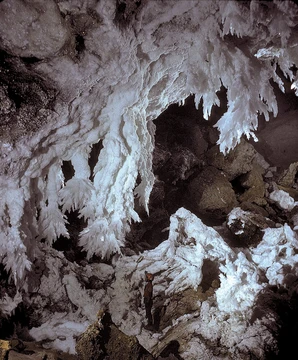
Wind Cave National Park sits about 10 miles north of Hot Springs in western South Dakota. It became the sixth national park in the United States on January 3, 1903, when President Theodore Roosevelt signed it into law, and it was the first cave anywhere in the world to receive national park status. The cave is famous for two types of calcite formations: boxwork and frostwork. Roughly 95 percent of all known boxwork formations on Earth are found inside Wind Cave.
The cave is also a classic example of a “breathing cave.” Air constantly flows in or out of its passages to balance the pressure inside with the outside atmosphere. When outside pressure is higher, air pushes in; when inside pressure is higher, air rushes out. Because Wind Cave is large but has only a few small openings, this breathing effect is especially noticeable. Rapid weather changes and sudden barometric shifts are common in western South Dakota. According to local lore, when the Bingham brothers first discovered the cave in 1881, a fast-moving storm was approaching, causing the barometric pressure to drop quickly. The cave’s higher-pressure air then blasted out through a 10-inch by 14-inch hole, creating the wind that gave the cave its name.
In terms of size, Wind Cave is the densest cave system in the world, meaning it has the greatest volume of passages per cubic mile of rock. As of 2025, explorers have mapped 168.02 miles of passageways, making it the sixth-longest cave globally and the third-longest in the United States. However, it is only the second-longest cave in Custer County, South Dakota, behind Jewel Cave. Despite their proximity, no connection has ever been found between Wind Cave and Jewel Cave, and most geologists believe they are not linked.
Above ground, the park protects the largest remaining natural mixed-grass prairie in the United States. It also marks the southern terminus of the South Dakota Centennial Trail.
The Lakota, Cheyenne, and other Native American tribes knew of the cave long before Euro-American settlers arrived, though no recorded evidence shows that anyone actually entered it. The Lakota called it Washun Niya and considered it a sacred place—the site where they first emerged from the underworld before the creation of the world. Their oral history tells of Tokahe, the first human to come out of the cave, symbolizing that emergence. Beyond its spiritual importance, the area around Wind Cave served as a vital resource, often called a “supermarket” by the Lakota. The cave’s shelter attracted game, making it an ideal spot for winter camps and hunting grounds.
The Lakota’s dispossession followed a familiar pattern. A treaty at Fort Laramie in 1851 established a legal relationship with the U.S. government, and another treaty in 1868 reduced the borders of Lakota land in the Black Hills. Article two of that 1868 treaty allowed forts to be built on Lakota territory. In 1874, General George A. Custer surveyed the land, and despite his geologist finding no significant gold, Custer mistakenly reported a major gold presence. Miners then flooded the hills in violation of the treaty, and the government did little to stop them. In 1875, the Lakota’s title to the land was declared invalid because they had not developed it structurally and were supposedly “wasting” it. The Dawes Act of 1877 opened the site to settlers, sealing the Lakota’s removal from their ancestral lands.
The first documented discovery by white Americans came in 1881, when Tom and Jesse Bingham heard wind rushing from a small hole. According to the story, when Tom peered in, the gust blew his hat off. For the next eight years, few people ventured far into the cave. Then, in 1889, the South Dakota Mining Company hired Jesse D. McDonald to oversee a mining claim on the site. The company may have hoped to find valuable minerals, or it may have planned commercial development from the start. No valuable deposits were found, so the McDonald family turned to tourism. Jesse’s son Alvin, then 16, began exploring the cave in 1890, and his brother Elmer joined in 1891. Alvin kept a cave diary and fell in love with the place. Others who helped explore and develop the cave between 1890 and 1903 included Katie Stabler, Emma McDonald (Elmer’s wife), their daughter Inez, and Tommy McDonald (Elmer and Alvin’s brother). By February 1892, the cave was open to visitors, with a standard tour fee.
- sixth_longest_cave_in_the_world
- True
- third_longest_cave_in_the_United_States
- True
Lore & Background
The Lakota, Cheyenne, and other Native American tribes were aware of the cave's existence, and the Lakota considered it sacred as the site where they first emerged from the underworld. Originally called Washun Niya, the cave played an important role in Lakota traditions and culture. The oral history tells of Tokahe, the first human to emerge from the cave. The area also served as a source of resources and hunting grounds for native peoples. McDonald to oversee a mining claim, but no valuable minerals were found. Jan and Herb Conn played an important role in exploration during the 1960s.
Reader's Guide
Wind Cave National Park holds significance as the sixth national park in the U.S. and the first cave anywhere in the world to be designated a national park. Its cave system is recognized as the densest in the world, with the greatest passage volume per cubic mile, and it contains approximately 95 percent of the world's discovered boxwork formations. The cave is also one of the best known examples of a breathing cave, where air moves in and out to equalize pressure, a phenomenon that gave the cave its name. Above ground, the park protects the largest remaining natural mixed grass prairie in the United States. The park's bison herd is one of only four free-roaming and genetically pure herds on public lands in North America, and it is currently brucellosis-free. The park also hosts endangered species such as the black-footed ferret and whooping crane. The cave's exploration history includes early tours by candlelight and the work of the McDonald family and later explorers like Jan and Herb Conn. The park's visitor center features exhibits on geology, wildlife, and the Civilian Conservation Corps.
Did You Know?
- Wind Cave was the first cave to be designated a national park anywhere in the world.
- Approximately 95 percent of the world's discovered boxwork formations are found in Wind Cave.
- The Wind Cave bison herd is one of only a few free-roaming and genetically pure herds on public lands in North America.
Geological Marvel and Ancient Origins
The Jenolan Caves hold a distinction that few geological formations can claim: they are the oldest known and dated open cave system on Earth, with an age of approximately 340 million years. This remarkable figure was established through potassium-argon dating, a technique that measures the ratio of radioactive potassium to the trapped argon gas it produces as it decays. The clay deposits within the caves yielded this extraordinary age, and the research was spearheaded by a collaboration between CSIRO, the University of Sydney, and the Australian Museum. The cave network itself is vast, stretching over 40 kilometres across multiple levels with more than 300 known entrances, and it traces the path of a hidden underground section of the Jenolan River. Within its passages, visitors can encounter Silurian marine fossils and stunning calcite formations that sometimes gleam in pure white. Despite extensive exploration, the complex remains incomplete, with new passages still being discovered. Situated roughly 175 kilometres west of Sydney in the Central Tablelands, the caves and their 3,083-hectare conservation reserve form a geological treasure of global significance.
Indigenous Heritage and Living Memory
Long before European eyes ever gazed into their depths, the Jenolan area was woven into the spiritual and cultural fabric of the Gundungurra and Wiradjuri peoples, who knew the place by names such as Binomil or Bin-oo-mur. The Tharawal people also held the site in deep regard, referring to it as Binoomea, Bindo, or Binda. A central Dreamtime creation narrative of the Gundungurra tells of a cosmic struggle between two ancestral spirits: Gurangatch, a colossal eel-like being, and Mirrigan, a great native cat or quoll, whose conflict shaped the very landscape. The caves themselves played a sacred role in Gundungurra life; members of the community would penetrate the passages as far as the subterranean waters, carrying the sick to be bathed in this water, which they believed possessed healing power. The very name Jenolan is thought to derive from the Tharawal word Genowlan, meaning a high place shaped like a foot. A far less credible origin traces the name to J E Nolan, a phrase allegedly found smoked by candlelight on a cave ceiling.
European Discovery and the Dawn of Conservation
The precise moment the caves were first seen by Europeans remains shrouded in uncertainty, as no contemporaneous written account survives. Most narratives, penned decades later, credit James Whalan with stumbling upon the system around 1838 or 1841 while tracking a notorious ex-convict and thief named McKeown, who had made off with livestock, tools, clothing, and a flour grinder. James reportedly relayed his find to his brother Charles, who went on to conduct the first paying visitors through the passages in the 1840s. The caves were initially called the Fish River Caves. A landmark shift came in 1866 when the New South Wales Government assumed control, making the site only the second area in the world set aside specifically for conservation. The following year, Jeremiah Wilson was appointed the first official Keeper of the Caves. Wilson proved an avid explorer, discovering the Imperial, Left Imperial (later renamed Chifley), Jersey, and Jubilee Caves. By 1872, growing visitor damage prompted a ban on souvenir-taking and graffiti, and in 1884 the name Jenolan Caves was formally adopted.
Opening the Caves to the World
For early travellers, reaching the caves from Katoomba meant enduring a roundabout 140-kilometre detour via Tarana. In the mid-1880s, local hoteliers lobbied for a direct route, and in April 1884 surveyor William Marshall Cooper was dispatched to survey a horse-and-carriage track. His ten-day trek produced a 42-kilometre route he estimated at twelve hours on foot or five hours by ride, which became popularly known as the Six Foot Track. Parliament approved 2,500 pounds for construction in 1885, with the most arduous work involving a zig-zag cut through solid rock at the Megalong Cleft to tame the gradient to one in 5.5. Governor Lord Carrington made the first recorded passage in September 1887 and, upon arrival, became the first official visitor to the caves. The site's prestige continued to grow: the current Jenolan Caves House was erected in 1898 to replace Wilson's earlier wooden structure, which fire had partially destroyed in 1895. Today, eleven illuminated show caves welcome paying visitors, and the reserve was inscribed in 2000 as the most westerly component of the UNESCO-listed Greater Blue Mountains Area, while also holding a place on the Australian National Heritage List.
Frequently Asked Questions
What makes Wind Cave's mineral formations so special?
The cave is famous for its calcite structures known as boxwork and frostwork, which form intricate geometric patterns on the cave walls. Roughly 95 percent of all boxwork formations discovered worldwide can be found inside Wind Cave, making it the undisputed global showcase for this type of speleothem.
Why do cave enthusiasts and karst researchers regard Wind Cave as a must-visit site?
Because it holds the vast majority of the planet's known boxwork, visiting Wind Cave means seeing a formation type that is essentially impossible to find in meaningful quantities anywhere else. For fans of karst geology, it represents the single most concentrated example of that rare calcite pattern on the planet.
More in Caves And Karst Formations 1-24
Spotted an error? Know more?
This is a living reference — every entry is fact-audited, and reader corrections feed straight into our audit queue. Suggest an edit · See this site's audit record